A figure with a Kabbalistic notation of its creation date

The statue of St. John of Nepomuk in Niedźwiednik (German: Bärwalde) near Ziębice in the Lower Silesian voivodeship in Poland has a very unusual inscription, the meaning and form of which have probably been unrecognized until now - at least it is not mentioned in widely available materials produced after World War II.
The monument, crafted by Ludwig Andreas Jäschke[1], an artist based in Bardo, stands along the main road running through the village, at its beginning from the Ziębice side, to the right of the road leading to farms 96, 97, 99 (50°35'10.2"N 16°57'40.1"E). Near the statue flows an unnamed stream, a left tributary of the Oława river. Jan of Pomuk is depicted in a manner reminiscent of the monument on the Charles Bridge in Prague. Dressed in priestly attire, he wears a cassock, a surplice (lace cassock), a mozzetta (ermine cape) typical of a canon, with a biretta on his head and an aureole adorned with five stars above. The saint is seen adoring the cross, supported on his right shoulder and held with his left hand, placing his right hand on his chest. The twist of his body and the pronounced contrapposto are intended to give the figure a sense of dynamism and lightness. This is the most common portrayal of the vicar general of the Prague archdiocese in Lower Silesia. The sandstone sculpture stands on a rectangular pedestal adorned on the sides with volute flows; an inscription is present on its front face. The entire polychromed piece is set upon a larger rectangular, presumably brick, base.
Inscription
The most intriguing element of the monument is its unusually formatted inscription (photo 1). Apart from Latin words, it also includes numbers, with the date 1743 repeated four times, which is correctly interpreted as a date. The other numbers remained a mystery, and those describing the monument often dismiss them, stating that the inscription is incomprehensible, or that it contains mysterious sequences of numbers for unknown reasons. An attempt to decipher the inscription can be found on the nepomuki.pl website. However, the interpretation is incorrect, and regarding the numbers, the description ends with the helpless statement: Between the lines, about 23 groups of numbers and letters have been engraved, among which the date 1743 is repeated four times, confirming the foundation date of the object[2]
Kabbalistic notation of the date
It should be noted that the mysterious groups of numbers in each line add up to 1743. They themselves are the sums of letters to which numbers have been assigned in a way that refers to Kabbalah. So, we are dealing with a specific notation of the date, called kabbalistic[3].
First, we present the correct transcription of the inscription, which will explain the author's intention regarding the kabbalistic notation of the date 1743. It should be added that understanding what the numbers mean allowed us to determine the correct wording of words in which some letters were worn out or incorrectly restored during an inexpert renovation.
| Hanc | Molem | Pietas | Sacra | Struxit | Honori | ||
| 52 | (+) 135 | (+) 265 | (+) 175 | (+) 879 | (+) 237 | (=) 1743 | |
| Adami | Exulum | Orphanorum | Amato | Agenti | |||
| (+) 45 | (+) 755 | (+) 599 | (+) 182 | (+) 162 | (=) 1743 | ||
| Fideli | Ac | Consulto | Viduarum | Advocato | |||
| 53 | (+) 4 | (+) 553 | (+) 724 | (+) 409 | (=) 1743 | ||
| Male | Rumore | Et | Fama | Periculaniium | Felici | Patrono | |
| 56 | (+) 445 | (+) 105 | (+) 38 | (+) 666 | (+) 52 | (+) 381 | (=) 1743 |
| Sancto Ioanni Nepomuceno | |||||||
|---|---|---|---|---|---|---|---|
| Suggested loose translation: This monument was erected out of deep devotion for Adam the Exile and in honor of the beloved and faithful John of Nepomuk, helper of orphans and widows, defender against slander and ill repute[4]. | |||||||
The inscription has four lines (due to the width of the pedestal, each line consists of two unequal rows), beneath each word of which is a number representing the sum of the numeric values of its letters. At the end of each line, the sum of these numbers is always the same, that is, 1743. The fifth line is the name of the saint placed on the monument, and therefore is not suitable for creating a puzzle as in the previous lines.
The numbers (sums) beneath the words are derived in the following way: each of the 23 letters of the Latin alphabet is assigned a numeric value. This idea is taken from Kabbalah (gematria, or Kabbalistic numerology), hence the name "Kabbalistic date notation". The method of assignment is shown in the table below.
| A | B | C | D | E | F | G | H | I | K | L | M | N | O | P | Q | R | S | T | V | X | Y | Z |
| 1 | 2 | 3 | 4 | 5 | 6 | 7 | 8 | 9 | 10 | 20 | 30 | 40 | 50 | 60 | 70 | 80 | 90 | 100 | 200 | 300 | 400 | 500 |
By way of example, here's the calculation of the value for one of the words from the inscription
| Sum | ||||||
| 60 | + 9 | + 5 | + 100 | + 1 | + 90 | = 265 |
and for an entire line as well
| 1+4+1+30+9 | +5+300+200+20+200+30 | +50+80+60+8+1+40+50+80+200+30 | +1+30+1+100+50 | +1+7+5+40+100+9 | = 1743 |
This intricate and unusual method of dating was a kind of word puzzle, providing intellectual entertainment for both the composer and the reader, much like the chronostichs used in the same periods (16th-18th centuries, but mainly in the latter part of this period). The author often facilitated the verification of calculations, providing, as in Niedźwiednik, the sum of the numbers below the words. The intent was likely to indicate that this was a Kabbalistic puzzle, which without the conspicuous numbers might go unnoticed. Chronostichs were used both for dating manuscripts and prints, as well as other things, especially architectural objects or statues. Kabbalistic date notation, on the other hand, appeared mainly in manuscripts and prints, which is why the inscription on the monument of St. John of Nepomuk in Niedźwiednik is so unique. In the manual for auxiliary historical sciences, Józef Szymański provides two examples of Kabbalistic date notation. One is the dating of the work by Szymon Banaczkowski from 1760. Here, the notation serves as a chronostich as well. The second example is a manuscript from 1722 located in the Jagiellonian Library[3].
The reason for such a date notation appearing on a rural monument near Ziębice remains unclear. As mentioned, the creator of the statue is the prolific sculptor from Bardo, Ludwig Andreas Jäschke. However, he is not the author of the inscription. Crafting such an inscription would require a humanistic education and a high proficiency in Latin. It is highly probable that the sculptor created the statue, but it's very likely that the pedestal was crafted by a local stonemason. Of course, he isn't the author of the inscription either. Near Niedźwiednik, there are Cistercian monasteries in Henryków and Kamieniec Ząbkowicki. Bardo, where Jäschke worked, was under the Kamieniec abbey. Both monasteries owned many properties in the area, but Niedźwiednik wasn't one of them[5]. Nonetheless, it's possible that a monk, acquainted with the also anonymous founder, indulged in composing this intricate text. In the 18th century, the village had more than one owner, and these changed frequently. Was it merely a bored monk's playful puzzle-making, or a reflection of genuine interest and practice in occultism and astrology? Perhaps in the libraries of the Henryków or Kamieniec monasteries, there was a popular work of the time, "Three Books on Occult Philosophy" by Agrippa von Nettesheim, in which the second book describes how letters of the alphabet correspond to numbers, and this entire book is dedicated to celestial magic, or mathematics[6]. A mage can harness the perfection of numbers to influence objects of the sublunar, or earthly world. We can already decipher the form (date notation), but perhaps there is more to the Niedźwiednik inscription. It might have been an attempt to influence current events, as 1743 was a difficult year for the Duchy of Ziębice. War, change of power, the anticipated Protestant reaction - great uncertainty about the future.
This seems to be the only evidence of such date notation not only in the vicinity but throughout Silesia, if not beyond. One has to wonder why, in a deeply rural area and especially on a Catholic figure, such playful techniques were employed. To this question, we currently have no answer. The content of the inscription is quite enigmatic and seems artificial. This might be a result of the chosen format and the necessity to adapt words to the Kabbalistic puzzle. However, the mention of the forefather Adam could suggest that it wasn't merely a formal amusement by someone who encountered such puzzles and decided to apply their knowledge. Instead, they might have been aware and perhaps convinced of the "power" and significance of numerology, as mentioned above, often intertwining in individuals with astrology, occultism, and alchemy. Here, we've let our imagination run wild. While the matter of Frankenstein and Ząbkowice seems to have been settled to the detriment of the town in the Duchy of Ziębice, such a strange and unique inscription inevitably points towards some secluded alchemist in a suburban estate, seeking answers to the mysteries of the world, surrounded by local legends that continue to expand in ever-growing circles.
-
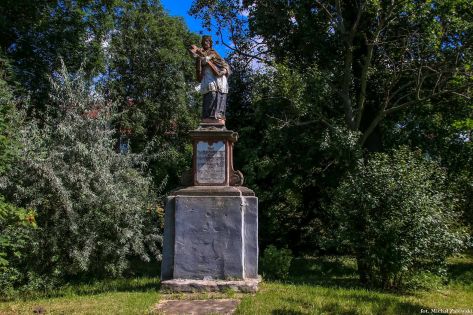
2. The monument of St. John of Nepomuk in Niedźwiednik, 1743
-
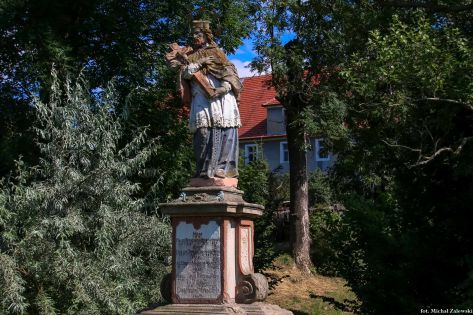
3.The statue of St. John of Nepomuk, Niedźwiednik
-
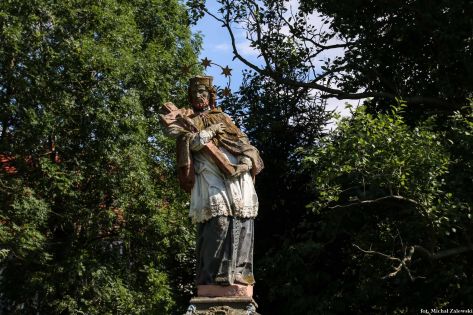
4. Stone sculpture of St. John of Nepomuk, Niedźwiednik


| Authors: Anna Kowalczewska, Michał Zalewski |
Footnotes
- ↑ Kolbiarz Artur. Nie tylko Praga. Udział śląskich rzeźbiarzy barokowych w dekorowaniu benedyktyńskich kościołów na Broumovsku. W: Barok na Broumovsku ze śląskiej perspektywy – historia i współczesność, red. A. Wojtyła, M. Wyrzykowska. Wrocław: 2018. s. 48.
- ↑ Cała próba brzmi tak: Na płycinie z przodu cokołu inskrypcja w majuskule łacińskiej potwierdzająca fundację tej figury przez cztery rodziny w roku 1743. Inskrypcja ta posiada zapis w treściach: "HANG / SZ / MOLEM PIETAS SACRAS TRUXh HONORI / ADAMI / EXULUM ORPHANORUM AMATO ABENTI / FIDELI / AC CONSULIO VIDUARUM ADVOCATO / MALE / RUMORE ET FAMA PERICLITANUM / FELICI PATRONO / SANCTO IOANNI NEPOMUCENO". Inskrypcja ta zawiera cztery zdania mogące oznaczać: "Rozmiar wielkości wyznaczony świętością patriotyzmu i honoru. Sierocy wygnańcy wielbią Cię. Rzecznik wspomagania dla wdów. Plotka niebezpieczeństwem w przekazach grupowych". Zakończenie inskrypcji zawiera treść: "Szczęśliwy mający (za) patrona Świętego Jana Nepomucena". Pomiędzy wierszami wyryto około 23 grup cyfr i liter, wśród których czterokrotnie powtarza się data 1743, co potwierdza datę fundacji obiektu. Napis został w części odnowiony ale z błędami (uzup.i tłum.: S. Zobniów). It's hard to deduce where the conclusion about the 4 families mentioned in the inscription comes from, as there's nothing about it in the proposed translation.
- ↑ 3,0 3,1 Szymański Józef. Nauki pomocnicze historii. Warszawa: PWN, 1983, s. 151.
- ↑ The translation is a loose suggestion. The inscription's text appears somewhat artificial and not necessarily fully aligned with biblical and hagiographic narratives. This undoubtedly stems from the difficulty in choosing the right words, whose letters, when converted to numbers, had to subsequently translate into a specific date..
- ↑ Wzgórza Niemczańsko-Strzelińskie Pogórze Paczkowskie tom II N-Z. M. Staffa red. Słownik geografii turystycznej Sudetów t. 21. Wrocław: 2008, s. 7-10.
- ↑ Heinrich Cornelius Agrippa von Nettesheim. De occulta philosophia libri tres. Köln: 1533, s. CXLIII, CXLIIII.

